|
MIDDLE EASTERN DANCE
THE EMERGENCE
OF THE NEW SACRED TEMPLE PRIESTESS
by Z-Helene Christopher
original page -paper
and articles
AUTHOR'S NOTE
The following is an expanded version of a presentation given on May 18,
1997 International Conference on Middle Eastern Dance at Orange Coast College,
Costa Mesa, California. Although I am not a dance historian by profession,
this paper is an assimilation of 20 years of personal research, experience
(performing and teaching), thinking and discussion concerning the ancient
Great Mother Goddess and her relationship to Middle Eastern dance. I would
like to thank my husband Richard Fink for his lively and inspiring thoughts
and opinions, as well as my friend Suzanne McAnna, librarian at the University
of Texas at Austin, for her help in gathering some crucial material for this
paper. -- Z-Helene Christopher
____________________________________________
She is known to us by
many names: Isis, Inanna, Astarte, Ishtar, Kali, Demeter, Aphrodite, Virgin
Mary, Ceres, Cybele, etc. She is the Great Mother Goddess and she has been
around for thousands upon thousands of years. She is, among other things,
eternal wisdom, fertility, death and renewal, healing, astrology, agriculture,
accounting, protection. And, with the exception of the Virgin Mary and a handful
of others, she is most often a sexual goddess whose ancient priestesses were our
predecessors 1.
I believe that as 1997 Middle Eastern dancers ushering in the new millennium we
need to reclaim and reconnect with some of the most sacred and healing
principles that these Goddess worshipping priestesses served.
But who were these priestesses? And what were they all about? Known in the
Near and Middle East by various names such as entu, quadistu, ishtaritu,
hierodoulai, devadasi, horae and har -the words whore and harlot come from these
origins- these priestesses were honored citizens of their day. They were
afforded much love, respect and wealth and possessed a great spiritual focus
when they performed dances, administered to temple rituals and activities and
had sexual unions honoring the Goddess and fertility and life mysteries
2.
Considered embodiments of beauty, love and compassion, they were viewed as
"sacred servants." In today's terminology, they are known by historians as
"sacred prostitutes." 3
But this term is confusing and is an oxymoron (for how can prostitution be
sacred?) and indicates a mindset that the ancients once held that we no longer
hold 4.
So what happened? Well, a bit of herstory is in order
(we usually only get history). In the ancient Mothertimes, before writing was
even invented and hunter and gatherer tribes were evolving to agricultural
based societies, sexuality and spirituality were considered as one, with no
separation of body and spirit. There was no concept of original sin; no
concept of the flesh as a source of defilement. The flesh was considered part
of the natural earth, which was revered for its procreative mystery
5. The
earth cycles became of paramount importance. When to plant, when to harvest,
the seasons, the weather, were all-encompassing issues and rituals -including
dancing and drumming- developed around them. These Goddess worshipping
cultures were in some instances--such as the Anatolian community of Catal
Huyuk (approximately 6,000 BC)--considered "gylanies" (gy meaning female, an
meaning male). Women and men worked together sharing equal status, with the
females predominating as priestesses
6.
Fertility was especially honored
7. Sacred dance led to sacred desire
which led to sacred sexuality which led to a cherished child who, under the
best of circumstances, would grow to adulthood to continue the life and death
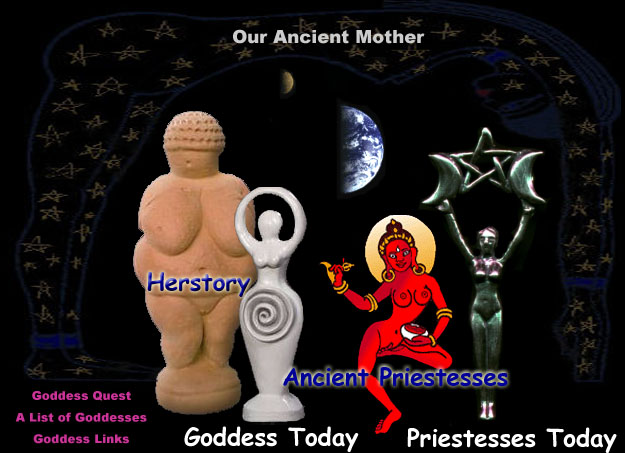
cycles. Many artifacts have been found showing an Earth Mother
deity--sometimes with large breasts and a pregnant belly, other times with the
head of a vulture--indicating the importance these ancients gave to the
Goddess's predominance over birth and death
8.
Many symbols found in ancient art on pottery and dwelling walls indicate
Middle Eastern dance's direct connection to early Goddess worshipping
cultures. It is no coincidence that we wear hip belts often featuring a
downward pointing triangle over our procreative area. This ancient symbol
represents the Goddess's vulva and womb
9. Along with the triangle, other
symbols of dynamic motion such as whirls, spirals, waves, winding and coiling
snakes, circles, crescents, V's and M's, have been passed down to us for
millennia as a moving, visual tradition and are the building blocks of our
dance vocabulary.
Then, as herstory continues, something happened. Between the years 4,300 BC
and 2,300 BC, a series of northern Indo-European invasions brought with them a
warring thunder/volcano God with a rule by king
10.
Goddess worshipping already had the concept of a vegetative, dying God who was
the Goddess's son-lover-brother consort. He was initially a lesser deity who
was known throughout the Near and Middle East as Damuzi, Tammuz, Adonis,
Osiris, Baal and Attis. He would annually make love with the Goddess, die
(sometimes be sacrificed) be mourned for and then resurrected. With the
northern invaders, however, the Goddess religion began to assimilate the
Indo-European male deity and there began to be more of a sharing of deity
dominance--a Ms. Goddess and Mr. God, so as to speak
11.
The "hieros gamos," or sacred marriage rite, reflected this. In this annual
Sumerian and Babylonian ceremony, a chosen favorite high priestess,
representing the Goddess, would have sacred sex, sometimes publicly, with the
prevailing king who was representing the God. The event would symbolically
ensure fertility of the land and bestow the Goddess's blessing on the king's
power to rule 12.
Over the course of 3,000 years the Goddess, who was initially predominant,
lost ground completely until her final demise in the year 406 AD when the
temple of Artemis at Ephesus (now Turkey) was looted and burned. Worship of
her went underground and there is much speculation that many of her followers
were burned as "witches" in the subsequent centuries
13.
What is important to remember here is that as the status of Goddess
worshipping declined, so did the status of women. The presence of the northern
invaders also brought about a gradual shift from gylanies--with a matrilineal
descent--to patriarchy--with a patrilineal descent
14.
Previously, women were afforded much freedom and sexual license. They chose
their own mates and the blood line always passed through them. With patriarchy
(rule by men) came the need to insure definite fatherhood and therefore it was
necessary to control female sexuality. Goddess worshipping, with its
exaltation of sexuality, had to be suppressed in order for patriarchy and
patrilineage to take hold. Women became increasingly subjugated
15.
We can easily trace the Goddess's decline (and women's) through the
surviving myths of early her/history and from the Judeo-Christian creation
myth. From the Mesopotamian Sacred Marriage of Inanna to the epic of Gilgamesh
to the creation story of the Enuma elish, we see her deteriorate from a
glorified, sexy and holy being to a demon monster
16.
Whereas Inanna praises her vulva and asks for her "holy churn" to be filled
with Damuzi's "honey cheese," 17
her sexual advances are rebuffed by the hero Gilgamesh and she becomes Tiamet,
the sea dragon, killed and dismembered by King Marduk in the Enuma elish.
By the time we get to the Canaanite Genesis story, female sexuality and her
desire to even have spiritual wisdom is punished by expulsion from Paradise.
Eve is responsible for the complete downfall of humanity and her sentence is
that childbirth be painful. By using the natural process of childbirth as a
tool for blame and punishment, the Genesis creation myth ensured that all
women giving birth would directly relate to the character of Eve, and thus, to
herself as "Evil." 18
Many believe, and it appears to be so, that Genesis was intentionally and
deliberately fabricated out of fragments of older myths specifically to
undermine Goddess worshipping 19.
Every symbol in the story was important to female deity followers. The tree
represented their asherahs or the living trees or poles that were often
situated next to Goddess altars. The snake, for millennia, had been a symbol
of the Goddess's eternal wisdom, with many Goddesses artistically depicted
wearing or holding them 20.
The eating of the fruit, symbolic of the concept of communion, was to partake
of "the flesh and fluid" of the Goddess
21. All these symbols were twisted and
turned in their meaning so that they would be viewed in a negative light.
Furthermore, one might consider Christianity a perfect culmination of deity
assimilation: Jehovah (Yahweh) as the thunder/volcano God, Jesus as the
sacrificed, dying God and Virgin Mary as a dismembered Goddess. The latter is
of particular importance in that she represented the Goddess in every way
except for one 22.
She was loving, beautiful, compassionate, procreative (with her cherished
son), but she was stripped of her sexuality and, in my opinion, symbolically
circumcised. Thus, a fatal blow was dealt separating sex and spirit and
resulting in the evolution of the unhealthy Madonna/Whore complex.
Continuing on to the Islamic tradition, we see that women were again blamed
for being sexual temptresses. They were veiled, secluded and literally
sexually circumcised 23.
This tradition continues today in the Middle East and Africa and is a heinous
act against girls and women. It clearly illustrates a deep and unhealthy
psychology in which men, women and children alike suffer.
And this brings us to the present. Where do we, as modern day Middle
Eastern dancers, stand in relation to all of this her/history? I believe that
we, as the new sacred temple priestesses, are in a unique position to
reconcile the sexual-spiritual schism that occurred when the
Judeo-Christian-Islamic traditions came into power and matrilineal gave way to
patrilineal societies. We do this through our bodies, our living presence, our
sexy and holy dance. But first we must reclaim and reconnect with some of the
ancient Goddess's most enduring and life sustaining principles. Now, I am not
advocating a return to sacred prostitution or to the Mother Earth religion per
se, but rather an assimilation of those aspects of these practices that are
most sacred and healthy for ourselves as individuals, our societies and our
planet as a whole.
There are four main points in which we, as new temple priestesses, reclaim
and reconnect with the ancient Goddess. First, we must understand our dance as
embodying nature, especially its fertility aspects. Our present body-spirit
schism coupled with our technological Western culture has led us to become
separated from nature 24.
Most of us do not grow our own food and are not intimately connected with the
land like the ancients were. We must be reminded of what is true and natural;
our dancing, with its visceral, organic appeal, does this. We also embody the
natural elements of Earth, Air, Water and Fire when we perform our earthy
beledies, airy veils, watery shiftitellies and explosive, hot drum solos.
|

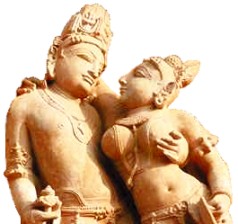
Statues at Lakshmana Temple
in Khajuraho, India. |
Our dance exudes fertility. We move our pelvises and
roll our bellies, honoring the sexual act and the resulting procreation
25. Our
dance has, for centuries, been used to teach and facilitate childbirth
movement and breathing, passed on from woman to woman. This actually resonates
from an earlier era when one of the functions of the sacred priestess was to
preside over childbirth and wet nursing
26.
We exalt our wealthy, fertile culture with our show of bodily adornments:
our costly, beautiful beaded breasts and hips, our expensive silky chiffons
and our well kept skin and hair. We communicate robust life forces; our eyes
and lips, open and full. With our lush, often rounded bodies, we revel in our
flesh! In a culture where bulimia and anorexia -literal denials of the flesh-
are quickly becoming the norm, it is healing for others to watch us do so.
Secondly, we reclaim and reconnect with the ancients by understanding our
dance as manifesting ecstasy. Artgasms are what my husband who
drums for me and I call them. These are those climatic moments when the
dancer, musicians and audience are viscerally transported to a heightened
awareness that is very satisfying for all. This can be a great taksim, floor
work or drum solo in which one can feel the energy shift in the entire room
and everyone's breathing changes, usually at once.
Our movement invokes the ecstatic kundalini--the sexual and spiritual life
forces symbolized by the coiled serpent asleep at the base of the spine--and
the whirling chakras--the seven energy centers that transmit and balance this
life force. Our full body undulations, what Tantric practitioners call the
dolphin wave 27,
connect the lower primal and sexual chakras (#1 & #2) with the higher
intuitive and spiritual chakras (#6 & #7) through the center (#4), our hearts.
Our vibrations and shimmies display ecstatic intensity as the dancer digs
deeper and deeper to sustain them. And the viewers are transformed as they
watch and experience the physical law that matter is both solid yet constantly
moving 28.
Thirdly, we reclaim and reconnect with the ancients by understanding our
dance as an experience of Divine Union
29. Be
it Hinduism, Taoism, Islam, Judaism, Christianity or Paganism, all great
religions satisfy the innate human need to feel connected to a universal
source. As dancers, we are the apex, the pinnacle that connects the individual
to him/herself and then to the community. We are at the center of a circle in
which the individual is lovingly received, transformed and then united to the
whole 30.
Our spins create this context along with our gestures to Heaven above and
Earth below. The group clapping and verbal soundings are part of the shared
experience. Similar to the function of the ancient hieros gamos, we dancers
embody the Goddess as her representative and the mystical union of masculine
and feminine, spiritual and physical takes place. The personal is transcended
and the divine entered in 31.
Fourth, we reclaim and reconnect with the Goddess by understanding
ourselves as dispensers of karuna; early motherly love that is
transformed in adulthood to embrace all forms of love: touching, tenderness,
compassion, mercy, sensual enjoyment and eroticism
32.
This is a prevalent feminine image throughout her/history: The Hindu Asparsas
who were heavenly erotic angels; the Grecian Three Graces known as Joy, Bloom
and Brilliance; the Greek, Persian, and Egyptian Horae who danced the evening
zodiacal hours.
When we perform, in essence, we make love to our audience. We enter and
say, "I love you, please love me." The audience receives our love and, if they
are open, loves us back. We create a love-fest and in this capacity we are
Love Goddesses. Our passion helps them feel their own emotions, be they joy,
grief or humor. For those whose hearts are armored, this can be a profound,
awakening experience.
Karuna is also dispensed through our personal beauty. We are exotic and
breathtaking to behold. We create more beauty with our beautiful movement. We
extend this beauty in a relationship to the audience who, in turn, are filled
and go out into the world to appreciate and create even more beauty.
And why all this beauty, love, passion and compassion? Why all this karuna?
We dancing priestesses serve a powerful function. We need to keep spreading
karuna, to keep filling our karuna coffers, so to speak, as a shield against
pain. Because sometimes life is not beautiful and loving and sometimes things
do not go well and the fields are fallow and sometimes sudden misfortune hits.
We need to balance the dark side of life with the light that we Goddess
representatives bring. In this capacity, we are again all important
reconcilers of opposites 33.
In conclusion, I would like to remind all Middle Eastern dancers,
regardless of what "style" they adhere to, that we have always administered at
important events and rites of passage. We have been there for the weddings,
birthdays, barmitsvas, baptisms, solstices and retirement parties. But our
presence, although auspicious, has been viewed by others, and sometimes
ourselves, as merely fun, secular entertainment. Yet we are so much more than
that! We are not there to just "embarrass" Joe on his birthday. We are there
to "honor" Joe on the fact that he was born! We are there to "celebrate" Joe
for having made it through so many birthdays! We are there to "bless" Joe so
that he may have a fertile, forthcoming year! And finally, we are there to
"love" Joe--even if we do not like him--so that his heart may be lovingly
filled and he can go and have sacred sex with whomever he wants. We do all of
this....and for fifty somewhat dollars! What a deal!
It is imperative that we create a vision within ourselves as sexy and holy
mediators between Heaven and Earth, body and spirit and male and female. I
suggest that we study the varied archetype of the Great Goddess and
consciously foster within ourselves those aspects of her we personally
resonate with. Furthermore, we must actively make any space we dance in, be it
the Holiday Inn or a concert stage, a sacred space, our own temple. I believe
that as we understand ourselves as facilitators of profound, transforming and
mystical experiences, the depth and potency of who we are and what we do will
be more fully appreciated and we will regain the love and respect that our
ancient priestess predecessors once enjoyed.
FOOTNOTES
1. Wendy Buonaventura, Serpent of the Nile (Interlink Books, New York, 1994),
pp. 32-33.
2. A. T. Mann and Jane Lyle, Sacred Sexuality (Element Books, Rockport, 1995),
pp. 38-42.
3. James Hastings, ed., Encyclopedia of Religion and Ethics (Sculner, 1925),
v. 6., "Hierodoulai," pg. 672.
4. Merlin Stone, When God Was a Woman (Harvest/Harcourt Brace, New York 1976),
pp. 153-163.
5. Buonaventura, Serpent of the Nile, pg. 30.
6. Marija Gimbutas, The Language of the Goddess (Harper and Row, San
Francisco, 1989), pg. XX.
7. Anne L. Barstow, The Book of Goddesses, ed. Carl Olson (Crossroad, New
York, 1983), pg. 7.
8. Ibid., pp. 11-12.
9. Gimbutas, The Language of the Goddess, pg. 99.
10. Stone, When God Was a Woman, pg. 67.
11. Ibid., pg. 68.
12. Mircea Eliade, ed., Encyclopedia of Religion (Macmillan, 1987), v.6., pg.
310.
13. Mann and Lyle, Sacred Sexuality pg. 37.
14. Stone, When God Was a Woman, pp. 30-61.
15. Ibid., pg. 179.
16. Starhawk, Truth or Dare (Harper, San Francisco, 1990), pp. 40-64.
17. Diane Wolstein and Samuel Noah Kramer, Inanna (Harper and Row, New York,
1983), pg. 39.
18. Stone, When God Was a Woman, pg. 222.
19. Ibid., pp. 198-223.
20. Amy Peck, "Re-Visioning Adam and Eve," Habibi (Habibi, Santa Barbara,
Winter 1995), Vol. 14, No. 1, pp. 8-9, 25, Contains detailed account of snake
denigration.
21. Stone, When God Was a Woman, pg. 216. 22. Mann and Lyle, Sacred Sexuality,
pg. 132.
23. Elizabeth Artemis Mourat, The Illusive Veil (unpublished, 1995), Part 1,
Section A.
24. Deena Metzger, "Re-Vamping the World: On the Return of the Holy
Prostitute," Utne Reader, Aug, Sept 1985, pg. 122.
25. Buonaventura, Serpent of the Nile, pg. 28.
26. Joan Goodnick Westenholz, "Tamar, Quedesa, Qadistu, and Sacred
Prostitution in Mesopotamia," Harvard Theological Review, 82:3, July 1989, pg.
252.
27. Amy Hubert, "Opening the Gates," Habibi (Habibi, Santa Barbara, Spring
1996), Vol. 15, No. 2, pg. 25.
28. Andrea Deagon, "Dance, Body, Universe" Habibi (Habibi, Santa Barbara,
Spring 1996), Vol. 15, No. 2, pg. 27.
29. Mann and Lyle, Sacred Sexuality, pg. 182.
30. Kenneth Ray Stubbs, ed., Women of the Light (Secret Garden, Larkspur,
1994), pg. 164.
31. Nancy Qualls-Corbett, The Sacred Prostitute: Eternal Aspect of the
Feminine (Inner City, Toronto, 1988), pg. 40.
32. Barbara G. Walker, The Woman's Encyclopedia of Myths and Secrets (Harper
and Row, San Francisco, 1983), pg. 495.
33. Qualls-Corbett, The Sacred Prostitute: Eternal Aspect of the Feminine, pg.
84.
BIBLIOGRAPHY
Barstow, Anne, L. The Book of Goddesses, ed. Carl Olson (Crossroad, New York,
1983).
Buonaventura, Wendy. The Serpent of the Nile (Interlink Books, New York,
1994).
Deagon, Andrea. "Dance, Body, Universe," Habibi (Habibi, Santa Barbara, Spring
1996), Vol. 15, No. 2.
Eliade, Mircea, ed. Encyclopedia of Religion (Macmillan, 1987), V.6.
Gimbutas, Marija. The Language of the Goddess (Harper and Row, San Francisco,
1989).
Hastings, James, ed. Encyclopaedia of Religion and Ethics (Sculner, 1925,
V.6., "Hierodouloi."
Hubert, Amy. "Opening the Gates," Habibi (Habibi, Santa Barbara, Spring 1996),
Vol. 15, No. 2.
Mann, A. T. and Lyle, Jane. Sacred Sexuality (Element Books, Rocksport, 1995).
Metzger, Deena. "Re-Vamping the World: On the Return of the Holy Prostitute,"
(Utne Reader, Aug,/Sept 1985).
Mourat, Elizabeth Artemis. The Illusive Veil (unpublished, 1995).
Peck, Amy. "Re-Visioning Adam and Eve," Habibi (Habibi, Santa Barbara, Winter
1995), Vol.14, No. 1.
Qualls-Corbett, Nancy. The Sacred Prostitute: Eternal Aspect of the Feminine
(Inner City, Toronto, 1988).
Stone, Merlin. When God Was a Woman(Harvest/Harcourt Brace, 1976).
Starhawk. Truth or Dare(Harper, San Francisco, 1990).
Stubbs, Kenneth Ray, ed. Women of the Light (Secret Garden, Larkspur, 1994).
Walker, Barbara G. The Woman's Encyclopedia of Myths and Secrets (Harper and
Row, San Francisco, 1983).
Westenholz, Joan Goodnick. "Tamar, Quedesa, Qadistu, and Sacred Prostitution
in Mesopotamia," Harvard Theological Review, 82:3, July 1989.
Wolkstein, Diane and Kramer, Samuel Noah. Inanna (Harper and Row, New York,
1983).
© Copyright 1997 Z-Helene Christopher, All Rights
Reserved
© Copyright 1997 Thundula Productions, All Rights Reserved
Do not replicate by any means (including any e/mail, photocopying, printing,
quoting, links to other sites, etc.), in part or in whole, without written
permission from the author.
|