Sluts, tramps, harlots -- such women populate the pages of the Hebrew Bible, mostly authored by men. Yet the prostitute par excellence of the New Testament, Mary Magdalene, remains an enigma. Nowhere does it say she lived a life of prostitution. Yet her image as a repentant whore has fascinated painters, preachers, playwrights and the public down the ages. Mary is the one from whom Jesus expelled seven demons, the one who washes, anoints and massages him, who witnesses his death and burial and is the first person to whom he appears after his Resurrection. She is likewise the woman who has long haunted the dreams and waking hours of actress Anita Stenger Dacanay. After a year of reading every book she could corral about Mary Magdalene -- both scholarly and fictional -- Dacanay wrote a play about her, titled “Qadishtu.” The word is Akkadian, the Semitic language of Mesopotamia, and refers to women who lived in temples in the goddess-worshiping civilizations of the Holy Land and parts of the Middle and Near East. Scholars have labeled these women “prostitutes,” probably because of their liberal sexual practices, Dacanay believes. Yet she has learned that the literal translation for qadishtu is “sanctified” or “holy women.” What if these women were, as some scholars hold, priestesses in the tradition of goddess worship? Could Mary Magdalene have been one of them? What was her relationship to Jesus? These are some of the questions that Dacanay, who performs the one-woman show, raises with her audience. The playwright is also concerned about Mary’s significance to women of today. She’s convinced that Mary Magdalene represents every Christian woman. Her depiction as a sinful penitent -- the classic fallen woman -- is part of the heritage that has been yoked to women in the church for centuries, up to and including our own, Dacanay said. She spoke with NCR at JFK International Airport here in February en route to Chicago, where she lives with her husband, Gary. Dacanay is a member of the Still Point Theatre Collective, a ministry of St. Stephen’s Lutheran Church in suburban Lincoln Park. The actress has been touring with the company’s “Points
of Arrival; a Jean Donovan Journey.” The play depicts one of the four
American religious women raped and murdered by Salvadoran soldiers in 1980.
A cruel, distant god Whether in Chicago or on the road, Dacanay, 32, admits to a 15-year struggle to reconcile the anger she has felt toward the Catholic church in which she was raised and her deepening relationship with the person of Jesus. “I believe the greatest abuse I suffered as a child, an adolescent and an adult was the idea propounded by my mother, the church and society that God was a man,” she said. Dacanay felt that God the Father “represented something cruel and distant and very male” -- a God who could extract a “horrible” death from his beloved Son. By contrast, she found Jesus’ humility, grace, compassion and courage to be qualities more common to women than to men, she said. “In Jesus I was able to see a bit of what I could truly be if I learned to love well.” The playwright described the birthing of her drama as “excruciating” and watched herself “vacillate between excitement and sheer terror.” Prayer, meditation, reflection along the shore of Lake Michigan and hearing Mary Magdalene’s voice “in snippets and whispers” all went into the work, she said. Dacanay wondered if the reason for Christ’s great love for Mary Magdalene was “because she possessed her own spiritual strength and wisdom, because she herself was a child of the Goddess, [a child] who knew and claimed her rightful place on earth and who refused to apologize to the men in power in Jerusalem for being a strong, self-actualized woman.” Dacanay’s probings lead her to “despise and disclaim” the “prophetic slut” image that she said the church has imposed on Mary Magdalene only to have it taken up in pop culture. The readings started her on a journey of recognition and worship of the feminine divine. Dacanay said that her spiritual searchings were not so much attempts to find a new religion, but to discover how so many had embraced a creed that so suppresses women. For her, religion is at best a vessel in which to hold
our faith. It gives us a structure, guidelines and a path by which to
express our souls, she said. A new consciousness On her way to rediscovering the feminine divine she talked of detours she’d made into Native American spirituality, New Age, Buddhism, yoga and most recently Wicca -- all of them leading her to an awareness of the divine feminine and of the holiness of all creation, she said. Dacanay is convinced that a new feminine divine consciousness is forming on the planet. The fact that many other women also identify with this concept is, she said, a result of their struggles, their feelings of alienation and loneliness, and their choosing at times solitude and at other times sharing, but always an interconnectedness to the divine. For Dacanay, the divine includes and reveres the feminine alongside the masculine. Millennias of patriarchy and church teaching -- from the evils attributed to Eve, the first mother, to the Catholic church’s perception of women as unfit for priesthood today -- have silenced the souls of many women, she fears, and have caused them to feel unworthy. Dacanay was reduced to sobs last year when attending Mass in Toronto and hearing the words: “Lord, I am not worthy.” It echoed much of the patterning of her youth and of her Ohio Catholic school education, she said. Still, on that trip, she made friends with a Canadian Jesuit who has helped her find peace while mourning the loss of the religion that has played such a large role in her life. Perhaps that is why the last scene of “Qadishtu” has Mary Magdalene kneeling to wash feet. Even though some who’ve seen the play in Baltimore and Chicago have been troubled by such a depiction, Dacanay sees it as the place where forgiveness can occur and where women’s work of caretaking for others across the ages is acknowledged. The actress-playwright has layered “Qadishtu” with
elements drawn from both goddess religions and Christianity, employing
songs, readings and audience participation rituals in the hope of creating a
healing ceremony as well as an interesting piece of drama. Over 75 minutes
she has the character of Mary Magdalene lead the audience through the story,
and she invites them to worship with her. Interspersed are monologues
chronicling Dacanay’s own faith journey in writing the play. A wise, complex woman The work explores such spiritual themes as love, loss, forgiveness, healing and resurrection. To date the show has raised many questions from its different audiences, just what Dacanay intended. Her goal was not necessarily to provide a more sympathetic understanding of Mary Magdalene, but to show that her story and that of many women have been oversimplified and not given the credit they deserve, she said. Whoever Mary Magdalene was, “I know she was more wise, more complex and more wonderful than the two-dimensional view of her that has come down to us. ... If I on a microcosmic level can create something that never existed before, then on a macrocosmic level we can create something new and better together,” Dacanay told NCR. What she wants is a world of peace. For women, it just might have to begin with peace between the sexes, she said. The age-old gender war is both unnatural and manmade, she said. “It’s about culture and learned behavior” that have been the norm of patriarchy for only 5,000 years. What’s required for peace is to step away from the paradigm of one person having to be over another to survive, she said. Dacanay believes that such a peace “can break out at any time.” It only requires “a community in which everyone is revered, respected and esteemed.” [Bishop Thomas Clary of the Free Catholic Church and Society of Mary Magdalene comments on the suppression of Mary Magdalene's knowledge of secret mysteries:] I find this interesting: in the Gnostic Gospel of Mary when Mary Magdalene had information revealed to her by Jesus, Peter and Andrew wouldn't believe that she, as a woman, could receive this kind of information which "should" only be given to them (10-19). And the ten pages explaining the secrets she received were conveniently missing. +Thomas One wonders, were these pages literally ripped from the ancient manuscripts? Top Temple Prostitutes, Temple Virgins, were they Temple Priestesses?
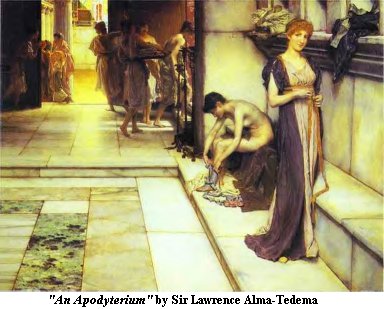
We know there was the Women's Court at both Solomon's Temple and the Second Temple in Jerusalem, and we know there is mention of the practice of sending young women there to "work." Mother Mary is said to have been dedicated to Temple work, she lived there, wove tapestries, altar cloths, prayed for the betterment of the people, etc. She is repeatedly called a "Temple Virgin" and apocryphal books tell of her adventures there under the Highpriest Zacharius. [Gospel of the Birth of Mary, written 300's AD, supposedly written by Matthew, and the Protevangelion, written by James, Yeshua's brother, one of Mary's other sons]. At one point another priest, Abiathar, wants Mary, known as a magikally powerful and beautiful priestess, to marry his son. It was custom after their service to the Temple, to give the Temple "Virgins" in marriage to prominent men of the community, usually nobles or priests. The Highpriest is perplexed what to do with Mary, she cannot marry just anyone, and so he enters the Holy of Holies and asks the Divine to send a sign. That's how she ends up betrothed to Joseph. Ancient pagan temples of both Old and New Testament times were populated with sacred "prostitutes." But these women were NOT what we consider prostitutes today. They were highly respected representatives of whichever goddess whose temple they served in. The words used to indicate them are not "whore" or prostitute, but Hierodules or Hetera (singular) heterae (plural), meaning sacred dedicant, sacred temple-worker. My friend, a sort of historical columnist, Joseph Kerrick writes:
When Mary Magdalene was called a hetera or prostitute back in the early centuries of Christianity, the people of the time knew perfectly well what that meant, she was a Temple Priestess, serving the Goddess. Perhaps she was such a priestess, the ubiquitous name of "Mary" has been attributed to the fact that it might not be a woman's specific name at all, but might mean a priestess of the goddess religion. Either way, Mary Magdalene did have a life before she joined Yeshua's ministry, but we now know it was not selling her body on the street like modern-day prostitutes. What about Mother Mary? Did she actually sleep with men in the Temple? We will never know, but we do know the story of Pantera, a Greek-born Roman soldier assigned to guard the Temple precinct in Jerusalem. "News" records of the time say he met, and perhaps wooed, a Temple Tapestry weaver named Mary then got her with child, a child later claimed to be conceived of God. This story is historically recorded in the Jewish writings of the time, the Talmud, and even in a Roman record book. Jewish writings from the first century go on to say it was the same Mary who gave birth to the Christian messiah, Jesus. Even more fascinating, in the 1990's, the grave of Pantera was uncovered in Germany, and sure enough he lived during the time of Jesus' birth and was even stationed in Jerusalem at the time! He was the head of a legion in his later years and had been transferred to fight in Germany, but died there in his late 40's. Ian Wilson discusses the Pantera evidence in his book Jesus the Evidence. We know that Yeshua was divinely conceived, but some religionists like to think he still had a human "sperm donor" to make the baby start growing inside Mary's womb. Those of this camp assume that was Joseph, but since he protested having never slept with her, perhaps God used this Greco-Roman soldier with the fascinating name. Pantera may be a mixed form of Hebrew and Latin, Ben-Terra, which means Son of the Earth Goddess). Ah, the stuff of legends
Sasha writes: I found the following
article at, http://www.cgocable.net/~ eulogia/faithnews/ (which
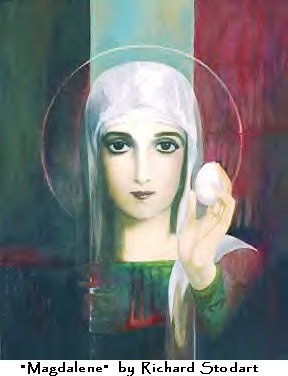
does not exist anymore) Magdalene was a Christian leader, not a repentant prostitute By Victor Greto The Gazette Who is Mary Magdalene? A prostitute and sinner who repented after Jesus saved her from being stoned by a mob -- the same Mary who then saw the risen Christ first? According to some Christians and scholars, it's time to rethink the prostitute and stoning stuff. Mary Magdalene is becoming a role model for women who expect more important roles for themselves in their respective churches. And scholars use Mary Magdalene as a symbol of the important role of women in early Christianity, as they work out the implications of recently discovered ancient literature. The current reform of Mary Magdalene has centuries of church and art tradition to overcome. The non-biblical image of Magdalene as a repentant prostitute is an image that had been officially sanctioned by the Roman Catholic Church in the sixth century. And it's that image that has been perpetuated by dozens of Christian paintings and movies ever since. The misreading of Mary Magdalene, critics say, is almost as ancient as the Gospels of the New Testament themselves, if only because there are up to five different Marys in the Gospels and seven in the New Testament as a whole. The greatest damage done to Magdalene's reputation, however, is only partly the confusion of these Marys, says Sister Evelina Belfiore, director of Catholic education for the Colorado Springs, Colo., diocese. The main problem is the way some decided to identify an unnamed woman with Magdalene in the Gospel of Luke. In 7:37-38, Luke tells the tale of a woman, "a sinner" who goes into a dinner party and anoints Jesus' feet. The following chapter immediately introduces "Mary, called Magdalene, from whom seven demons had gone out. . . ." "In the early church," Belfiore says, "as people have placed her in art and legend and misinterpretation, they linked her with the sinner from the chapter before." Take Martin Scorsese's `Last Temptation of Christ' as one of the more recent examples. In the film, based on the Nikos Kazantzakis novel, Magdalene is portrayed as a prostitute and is identified with another episode often included in the Gospel of John 8:3-11, in which Jesus stops a crowd from stoning a woman for prostitution. There is no indication in the text that either unnamed woman is Magdalene, but tradition has linked her with Magdalene. Why? That link, Belfiore says, came about in the early church of later centuries "and may have been associated with the oppression of women. Before that, women were ordained deaconesses. Then, there was a turnabout, excluding women from the sacred and from orders. Mary Magdalene had such a privileged role in the Gospels that it seems there was an attempt to put her in a bad light." Which is exactly what Sister Christine Schenk says she is trying to reverse. Schenk is executive director of the Cleveland-based FutureChurch. Two years ago, Schenk's group in conjunction with another Catholic group, Chicago-based Call to Action, launched the national observance of a July 22 feast of Mary Magdalene. It has grown from 28 prayer services last year to a reported 100 services this past July. "The Mary Magdala project emerged," Schenk says, "because it makes contemporary biblical scholarship available, and it provides woman ministers to preside at a prayer service." Schenk says her group is not calling for women's ordination but for "women's equal call to ministry in the Catholic Church." Schenk said the Magdalene services include a "brief reflection on Mary of Magdala," and what she calls "the right of naming." That is, when Jesus calls Magdalene by her name in the Gospel passage John 20:17, "she recognized him" as the risen Christ, and she was called as a disciple. Schenk thus sees Magdalene as representing a woman's call to discipleship. In the past, she says, women have internalized the idea that they weren't as holy or as good as men. The Magdalene services are "a real healing for many participants," she says. The emergence of women in organized religion is not only a Catholic issue.The Rev. Patricia Westlake of Trinity United Methodist Church in Colorado Springs, Colo., says she believes Magdalene was present at the Last Supper. And she believes other female disciples were on a par with the more famous 12 male apostles. In two of his letters, St. Paul also mentions important women of the early church. "For me, the Scriptures give [women] a prominent role," Westlake says. "Jesus gave them a prominent role. It's our culture that doesn't give them a prominent role." Feminist scholars of early Christianity see Mary Magdalene as indicative of what happened to women in general in the early church. "In the last twenty years, the history of women in ancient Christianity has been almost completely revised," writes Karen King in a recent essay about women in early Christianity. King is a professor of New Testament Studies and the History of Ancient Christianity at Harvard University's Divinity School. King writes that the early Christian women we thought we knew have almost nothing to do with the revised portrait that scholars are just beginning to unveil. "Chief among these is Mary Magdalene," she says. "Discoveries of new texts . . . have now proven that [her reputation as a repentant prostitute] is entirely inaccurate. She was indeed an influential figure, but as a prominent disciple and leader of one wing of the early Christian movement that promoted women's leadership." Among the newly discovered texts King is referring to is `The Gospel of Mary,' discovered at Nag Hammadi in Egypt more than a half-century ago. In that Gospel, Mary receives secret revelations from Jesus -- much to the chagrin of Peter.`The Gospel of Philip,' also discovered at Nag Hammadi, shows yet another understanding of Mary's relationship with Jesus. "But Christ loved her more than all the disciples and used to kiss her often on the mouth," that Gospel reads. "The rest of the disciples were offended by it and expressed disapproval. They said to him, `Why do you love her more than all of us?' The savior answered and said to them, `Why do I not love you like (I love) her?' " Scholars say they are not arguing that these are historically truer portraits than those of the New Testament Gospels. But they argue that these Gospels show there were early Christian communities that traced their beliefs back to a figure known as Mary Magdalene -- which had nothing to do with the traditional figure of a repentant prostitute. Even those women in established religions who do not accept the non-canonical Gospels as legitimate sources see hope for women in a closer reading of the four Gospels of the New Testament. "I think she's a model for women today," Belfiore says of Magdalene. "That when Jesus spoke to Mary to go tell the other disciples he was risen, it shows that woman has a complementary role in the mission and that we need one another. It's not a man's church or a woman's church, but a church. Women have a specific dimension of the mission." Mary Magdalene meets Tiberius. As believed and taught by the Eastern Orthodox Church for over 1500 years. [Of course no mention is made of her marriage to Yeshua/Jesus. That part of the legend has been suppressed by the authorities and kept secret by the Esoteric Christians. There is little doubt, now though, that they were indeed a married couple and produced offspring. Read Holy Blood Holy Grail for all the fantastic details.] On the back of my Society of Mary Magdalene membership welcome card it says: According to the ancient tradition of the East, Mary Magdalene was a wealthy woman from whom Christ expelled seven "demons." During the three years of Jesus' ministry she helped support him and his other disciples with her money. When almost everyone else fled, she stayed with him at the cross. On Easter morning she was the first to bear witness to his resurrection. She is called "Equal to the Apostles." The Eastern tradition tells us that after the Ascension she journeyed to Rome where she was admitted to the court of Tiberius Caesar because of her high social standing. After describing how poorly Pilate had administered justice at Jesus' trial, she told Caesar that Jesus had risen from the dead. To help explain his resurrection she picked up an egg from the dinner table. Caesar responded that a human being could no more rise from the dead than the egg in her hand turn red. The egg turned red immediately, which is why red eggs have been exchanged at Easter for centuries in the Byzantine East. Mary traveled the Mediterranean preaching the resurrection. Like Peter and Paul, she died a martyr and she bears witness to the important role women once held in the Church. This icon (on the front of the card) was commissioned for Grace Cathedral in San Francisco to commemorate the election of Barbara Harris, the first woman bishop in the Anglican communion. As women reclaim their ancient rights in the church, Mary Magdalene challenges all Christians to re-examine their cultural prejudices about gender and leadership. The inscription at the bottom of the icon reads: "Saint Mary Magdalene." This title is written in Syriac, a dialect of the language spoken by Jesus. The Gospel comes to us most directly, not from Rome or Greece, but from the deserts of the Middle East. We owe our faith to Semitic Christians like Mary Magdalene. With this debt in mind, let us hear their voices in the Palestinian cries for justice in our own day.
************************************** A few comments from Katia on the above.... I am not sure about that last line. Seems a bit like a political quantum leap there. But I like the passage as a whole. I'm also not certain if she was a wealthy woman, only the Gospel of Luke says so. No records really know if she died a martyr, there are many stories about her death. Arcane tradition says she died in Gaul (now France) somewhere near the coast where there were several Jewish villages she might have settled in to raise her children. As for the red eggs, the Eastern Orthodox Church, which includes the Russians, is indeed fond of blood red eggs at Easter, with gold letters painted on them. They do it every year. You have to start with a brown egg in order to get the rich dark red color. The icon on the card is a wild alien looking Mary Magdalene. It has the Syriac writing on it. If you want one yourself, all you have to do is join the Society of Mary Magdalene by sending them a year's dues of $15. Their website is www.MaryMagdalene.org • • • • • • • • • • • Here are some helpful links discussing the relationship between Jesus Christ and Mary Magdalene: http://thewhitemoon.com/mary/magdalene.html#BRIDE http://www.grailchurch.org/marriedjesus.htm
The Sacred Reunion Shrouded in mists of time Son of the Father, "The Bride is as dark--- The Bride, Eagerly she sought him, Noli me tangere: The Ascended One, But now, at last, he seeks her. Her heart beats faster. The garden where he left her At last he finds her, He whispers her name, |
This page last updated: 03/01/2018